

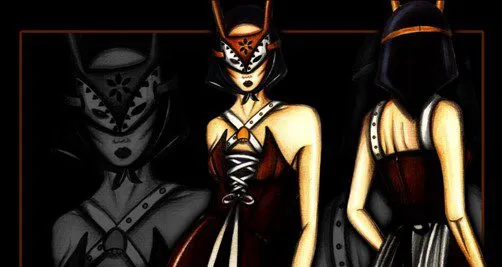
Viviana Pes's degree thesis, "The mask. From the Dionysian carnival to the catwalk": the Màscaras collection inspired by Sardinian ritual masks.
Artefact. Foreword by Generoso Matteis.
(…) A mask is an artefact worn to cover the whole face or only the eyes. It has been used since prehistory for religious rituals, theatrical performances or popular festivals such as carnival. (…)
from Wikipedia
The research developed in Viviana Pes’s thesis originates from the study of the ritual masks of Sardinia, a land rich in festivals sharing a common denominator of clearly agro-pastoral origin. The various Sardinian “Carnivals” seem to re-enact man’s ancestral struggle with nature, understood as a “magical” force that human beings must confront to ensure the survival of their communities. The protagonists, with their fascinating costumes and obsessive rhythms, are variations of a ritual with common origins and a common purpose: to drive evil, in this case famine, away from their communities.
By definition, an artefact materialises the pre-existing intention from which it originated; from the point of view of cognitive psychology, artefacts are first cognitive objects and only then concrete ones. After a careful and thorough analysis of the state of the art of all types of masks and costumes, the design process developed through an intense cognitive experience that led to a contemporary reinterpretation of the most significant details. These became the compositional inspiration for the collection, shaped by a creative approach often based on deliberate contrasts, at times even aggressive ones, that make the garments extremely fascinating.
A promenade of Dionysian rituals, typical of the Sardinian masks, materialises in garments with a dense narrative power: a sort of story in episodes that seeks to consolidate the tradition of the Sardinian community by bringing it into unusual contexts such as haute couture. In its broadest sense, physical or not, an artefact implies an intention to use the object, individual or social, expressed in “possible uses”; and it is precisely in the moment of use that it produces a cognitive change in human capabilities. The potential of the “Màscaras” collection lies in triggering a process of cognitive perception of Dionysian rituals, leading to the construction of new shared knowledge and thus influencing the reality around us through the innovation it brings.