

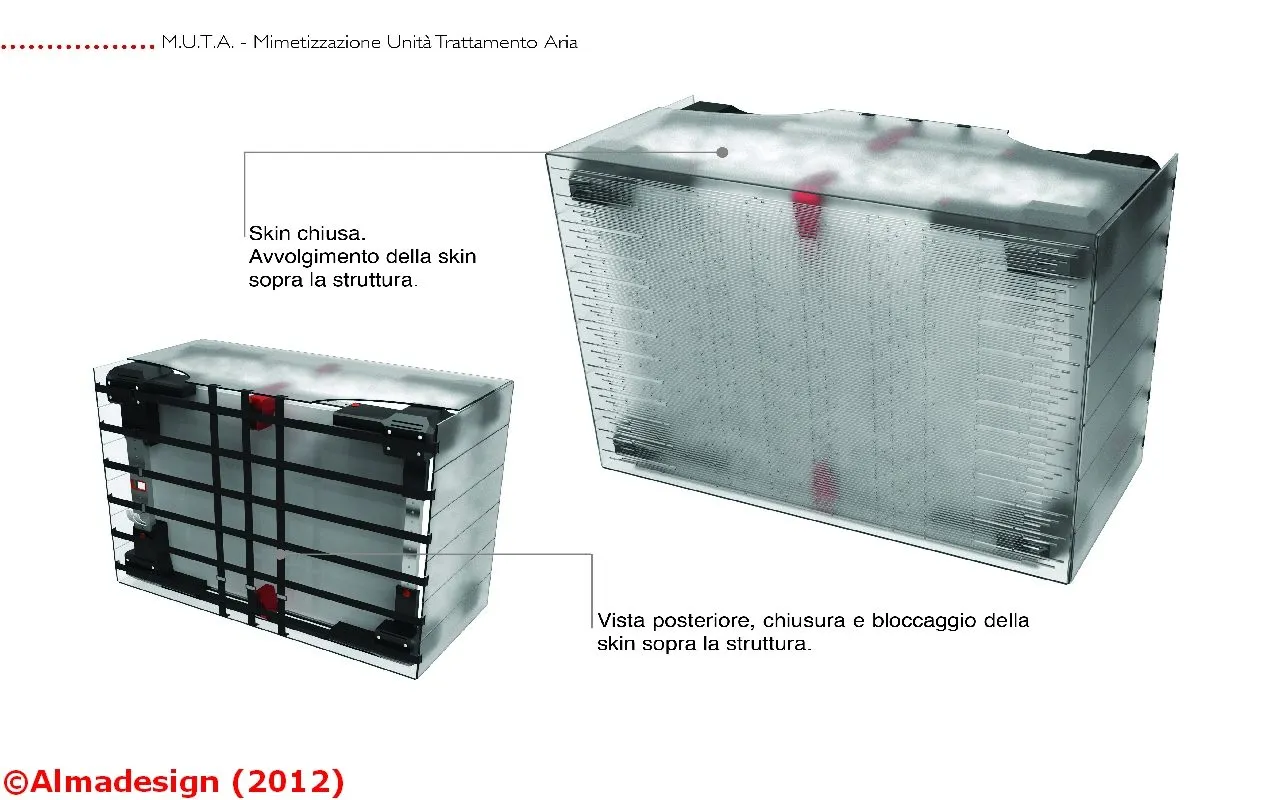
M.U.T.A. – Camouflage for Air Handling Units: a Master's thesis in Design on the environmental mimicry of air conditioners in historic centres.
Environmental emulation.
The research developed in this Master’s thesis in Industrial Design explores a minefield in the world of building services, specifically air handling. For years, in my everyday professional practice, I have constantly faced problems in this field: discussions with the mechanical engineers almost always focus on the performance of the equipment to be installed, and little room is given to its integration into context. In particular, the visual impact of the proliferation of air conditioners harms historic centres of cultural interest, which suffer the architectural blight of an invasion of noisy white boxes and cooling fans hung at random. The design focused on this field, and in particular on buildings listed by the Superintendence for Architectural Heritage or of special interest.
The study began with an analysis of the state of the art, which revealed no solutions able to reduce the visual impact without reducing the efficiency of the system. Metal structures similar to grilles are often used, anchored to the masonry, strong enough to support the units while allowing ventilation and integration with the rest of the building. Examples of this kind are very common in the Islamic world, where the ancient and exuberant decorative tradition has been rediscovered to integrate high-impact objects such as air conditioners, antennas and satellite dishes into the image of traditional buildings.
Particular attention was paid to industrial production and to the dimensions of outdoor units, in order to identify a dimensional range adaptable to the various models: a product that clashes with production logic cannot be introduced on the market. Assuming a drop-in installation of the unit, the design proposes a telescopic, dimensionally adaptable cage, connected by extendable straps to the indoor mounting plate of the split unit. The connections between inside and outside (electricity, gas and liquids) were resolved with solutions that pass through the window frames with limited destructive work on the building.
Once the technical and functional requirements were met, the design focus shifted to environmental mimicry, in the awareness that air conditioners cannot be made “invisible”. The cue came, by analogy, from the body-painting works of the Chinese artist Liu Bolin, known as “the invisible man”, in which the body merges with its surroundings. The “how” was suggested by the prototype of a “chameleon” robot made by Stephen A. Morin and colleagues at the Department of Chemistry and Chemical Biology of Harvard University, which reproduces the colours of its environment through a web of microchannels filled with fluids of different hues.
Through a technology transfer, a camouflage web could be created that “actively swallows” an awkward presence in the environment, reconciling the needs of building services with the protection of valuable architectural heritage.
— Arch. Generoso Matteis